The Complete Guide to Cloud Cost Optimization
Everything you need to know about reducing your AWS, Azure, and GCP cloud spend. From quick wins to advanced strategies — a comprehensive guide by CloudExpat.
Why Cloud Cost Optimization Matters
Cloud spending is the fastest-growing line item in most companies’ IT budgets. The average organization wastes 30-35% of its cloud spend on idle resources, oversized instances, and missed commitment discounts. For a company spending $100K/month on cloud, that’s $360K-$420K per year going up in smoke.
But here’s the thing: most of this waste is entirely avoidable. The challenge isn’t technology — it’s knowing where to look and having the discipline to act on what you find.
The Three Pillars of Cloud Cost Optimization
1. Eliminate Waste
The lowest-hanging fruit. Idle resources, unattached storage volumes, oversized instances, forgotten dev environments running 24/7 — these account for the majority of cloud waste in most organizations.
Key strategies:
- Rightsizing: Match instance sizes to actual utilization (most instances run at 10-30% CPU)
- Scheduling: Shut down non-production resources outside business hours
- Zombie resource cleanup: Find and terminate forgotten resources with no active owners
- Storage tiering: Move infrequently accessed data to cheaper storage tiers
2. Optimize Commitments
Reserved Instances (RIs) and Savings Plans offer 30-72% discounts over on-demand pricing. The challenge is buying the right mix without over-committing.
Key strategies:
- Coverage analysis: Identify stable baseline workloads suitable for commitments
- Right-sizing before committing: Don’t lock in discounts on oversized instances
- Blended approach: Use a mix of 1-year and 3-year terms to balance savings and flexibility
- Continuous monitoring: Utilization of existing commitments should stay above 80%
3. Architect for Cost
The most impactful but longest-term lever. Design choices made during architecture define your cost profile for years.
Key strategies:
- Serverless where appropriate: Pay only for what you use, eliminate idle compute
- Managed services vs. self-hosted: Calculate the total cost including engineering time
- Multi-region strategy: Not every workload needs to run in every region
- Data transfer optimization: Cross-region and cross-AZ transfer costs add up fast
Cloud-Specific Optimization
AWS Cost Optimization
AWS offers the most granular pricing and the most optimization levers. Key areas:
- EC2 rightsizing — The single biggest savings opportunity for most AWS customers
- S3 lifecycle policies — Automate transitions to Glacier and Intelligent-Tiering
- Reserved Instance and Savings Plan management — Requires continuous analysis as workloads change
- Lambda optimization — Memory allocation directly affects cost and performance
Google Cloud Cost Optimization
GCP’s committed use discounts (CUDs) and sustained use discounts offer meaningful savings with less management overhead than AWS RIs. Key areas:
- Committed Use Discounts — Simpler than AWS RIs, but still require analysis
- Sustained use discounts — Automatic, but understanding them helps with planning
- BigQuery optimization — Slot reservations vs. on-demand pricing
- GKE Autopilot — Reduces cluster management overhead and cost
Azure Cost Optimization
Azure’s pricing model includes unique options like Azure Hybrid Benefit and Dev/Test pricing. Key areas:
- Azure Hybrid Benefit — Bring your own Windows Server and SQL Server licenses
- Azure Reservations — Similar to AWS RIs but with more flexibility on exchanges
- Dev/Test pricing — Significant discounts for non-production workloads
- Azure Advisor — Built-in recommendations (but no automated execution)
Serverless and Modern Workload Optimization
Serverless doesn’t mean free. Lambda, Cloud Functions, and Azure Functions have their own cost optimization patterns — memory allocation tuning, concurrency management, and architecture choices that dramatically affect your bill.
Getting Started
The fastest path to savings:
- Connect your accounts to CloudExpat in 30 seconds
- See your waste — we identify optimization opportunities within minutes
- Execute with 1-click — rightsizing, scheduling, and commitment purchases, all with approval workflows
- Track ongoing savings — continuous monitoring catches new waste as it appears
Most organizations see significant savings within the first week.
Deep-Dive Articles

10 Methods of Reducing Cloud Costs on Google Cloud

Guide to Google Cloud's Cost Management Tools

Guide to Google Cloud's Committed Use Contracts

Serverless Cost Optimization 2025: Lambda vs Azure Functions vs Cloud Functions

AWS Auto Scaling: Best Practices and Strategies

Google, Amazon, and Microsoft Usher in the Era of Free Data Transfers
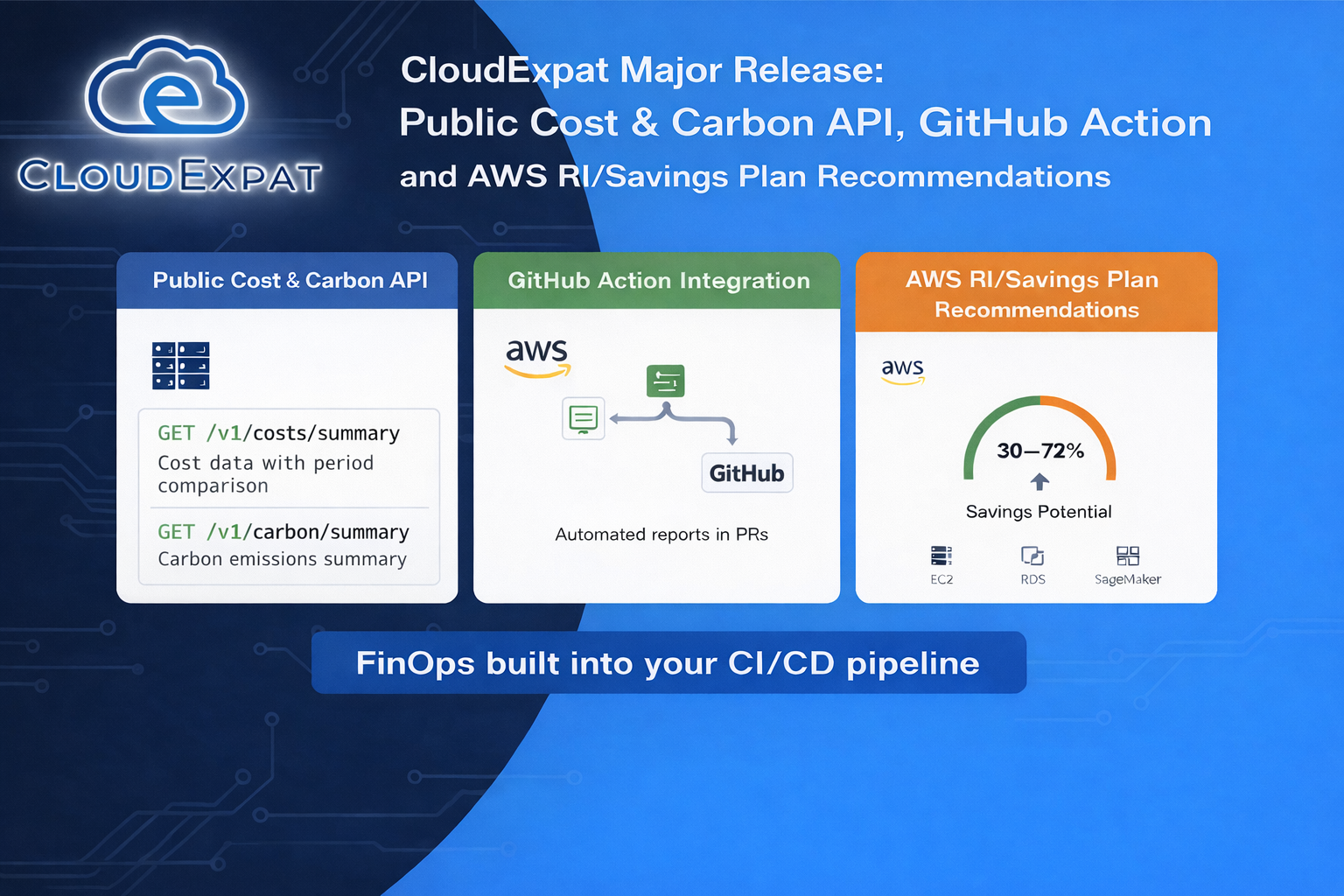
CloudExpat Major Release: Public API, GitHub Action & AWS RI/SP Insights

DeepSeek-R1 Hosting Benchmarks: Real-World Costs Across AWS, Azure, and GCP
Ready to Optimize Your Cloud Costs?
Connect your cloud accounts in 30 seconds. See exactly where you're overspending — no commitment, no risk.